
Mitchell County Criminal Docket Searches
Begin with the North Carolina eCourts Portal. Its Smart Search takes a record number or a party name typed last name first. Mitchell County joined the Odyssey system in July 2025. Its records now flow through this one public tool. The basic search needs no account. Registering simply lets you save cases under My Cases, and it still opens nothing restricted.
Enter the case number exactly as printed whenever you have it. Mitchell records filed under eCourts follow a pattern of year, case type, sequence, and county code. One synthetic example is YYCR000000-600. Keep in mind that Portal searches by party, not by charge. A charge description alone will not pull up a case.
- Open Portal and select Smart Search.
- Enter a record number or a name in last, first order.
- Add Location = Mitchell County, then use Criminal or Infraction filters only when they narrow the result.
- Select the underlined case number to open the Register of Actions and review available Case Events, Hearings, Dispositions, and Financial Information.
- Confirm a live setting through Search Hearings or the criminal calendar, then ask the clerk for an official or certified copy when needed.
Note: A search that hits 200 results needs a narrower name, a record number, or a Mitchell location filter.
Mitchell Criminal Portal Filters
The Advanced Filter Options only appear after you run a basic search. When a name pulls a broad result, pick Mitchell County. Then choose Criminal or Infraction. From there you can narrow by criminal status. The published choices include Pending, Disposed, Completed, Archived, Remanded, Transfer to Another County, Transferred to Superior Court, Pending Expungement, and Voluntarily Dismissed with Leave. A status filter shrinks the list. It does not replace reading the chronological record itself.
The North Carolina District Court overview lays out this division. It hears misdemeanors, infractions, and much of the early criminal work. In Mitchell, District Court files and later Superior Court files all lead back to the same county clerk. That holds even when the division changes.
That division split matters when you read a Mitchell criminal Register of Actions. An infraction or misdemeanor entry may start in District Court, while a felony runs through Superior Court.
Criminal Dockets: What They Show
A Mitchell criminal Register of Actions is a chronological public case record. It does not promise that every field or document will display. Portal can show Case Information, Assignment Information, Party Information, Case Events, Dispositions, Hearings, and Financial Information. Those appear when they apply. What actually shows depends on the record type, processing, and public-access rules.
| Record number | The case identifier, including Mitchell county code -600 in the post-eCourts pattern. |
|---|---|
| Case and assignment | Case Information and Assignment Information connect the matter to its record type and court division. |
| Parties | Party Information supports the Portal’s party-based public search. |
| Case events | A chronological log that can include documented warrant, summons, service, unserved, reset, and recall events. |
| Hearings and result | Hearings, Dispositions, and Financial Information appear where the case contains that public information. |
A public image may appear once Odyssey processing finishes. If none shows, that does not mean no paper file exists. The Mitchell County Clerk of Superior Court keeps the record.
Mitchell Criminal Charge Search Limits
Portal works by party. You can search a party name, record number, citation number, attorney, or business. There is no search-by-charge function. Typing an offense phrase can miss the case entirely. That can happen even when a public Case Summary exists. Start with the party name or record number. The case record then shows whatever classification and events are available.
Aliases tied to a case count in the search system. Portal never displays a name history, though. If a spelling is uncertain, use the last-name-first format. Then narrow the results to Mitchell County. Public date-of-birth results mask the month and day. Social Security information is not open for public validation.
Criminal Case Stages on the Docket
A criminal docket can trace a case from charging or process activity. It may show an arrest, summons, or warrant action. Later come first-appearance or bond activity, pretrial work, a plea or trial, disposition, sentence or financial activity, and finally an appeal or transfer. Every case runs in its own order. Magistrates issue warrants, set conditions of release, and handle preliminary work. They are District Court officers, though, not a separate Mitchell records system.
Docket flow: Filing → Arraignment → Pretrial → Plea or Trial → Disposition → Sentencing
For warrants, orders for arrest, and criminal summonses, Portal labels each event as issued, served, unserved, reset to unserved, or recalled. Treat these as event descriptions. They are not a ruling on the case.
Mitchell Criminal Docket Status Terms
Some Portal words look more final than they are. Pending means the record is still active in Portal's classification. Disposed means a disposition was recorded. Transferred to Superior Court, Appealed – Appellate, and Remanded describe procedural movement or return, not a finding of guilt or any other final outcome.
- Register of Actions
- Portal’s chronological activity record, also called the Case Summary.
- Transferred to Superior Court
- A status showing movement from a prior division into Superior Court.
- Pending Expungement
- A filter status that is not the same as a completed expunction.
- Search Hearings
- The Portal tool for a current setting by case, party, attorney, judicial officer, or courtroom.
Read the full event history and the current setting before drawing any conclusion from a single status word.
Mitchell County Criminal Docket Courts
Two courts divide the criminal work in Mitchell County. Felonies belong to Superior Court District 35. District Court District 35 handles misdemeanors, infractions, and traffic matters that surface on the local criminal calendar. Some felonies pass through preliminary District Court action first. A division change in the Register of Actions is therefore context, not a missing record.
One office keeps the files for both divisions. The Mitchell County Clerk of Superior Court maintains the registers at 328 Longview Drive, Bakersville, NC 28705. The unified office answers at (828) 688-5100 through the official courthouse listing. Visit the counter to inspect a paper file. You can also use the public terminal, request copies, or ask about certification.
Note: Magistrate activity stays inside the District Court record path. It does not create a separate justice-court docket.
Mitchell Criminal Calendar Checks
Once a Mitchell criminal Register of Actions is open, confirm the setting. Use the official criminal calendar or Portal's Search Hearings tool. That tool asks for a Mitchell location, hearing type, search type, and matching value. It also wants a date range. The case summary covers past and listed hearings. The hearing tool pins down the current date, place, and time.
District 35's administrative policy gives citations and magistrate orders an administrative court date. Defendants are called at 9:00 a.m. That habit does not make every 9:00 a.m. entry a final outcome. The ticket, the current calendar, Portal, and the clerk give the controlling answer.
Conflicts happen. Call the clerk, try the courthouse terminal, or inspect the paper file. The Clerk of Superior Court handles record custody. The Superior Court judges' office at (828) 737-6747 and the District Court judges' office at (828) 737-6712 take scheduling-administration questions.
Access Rules for Criminal Dockets
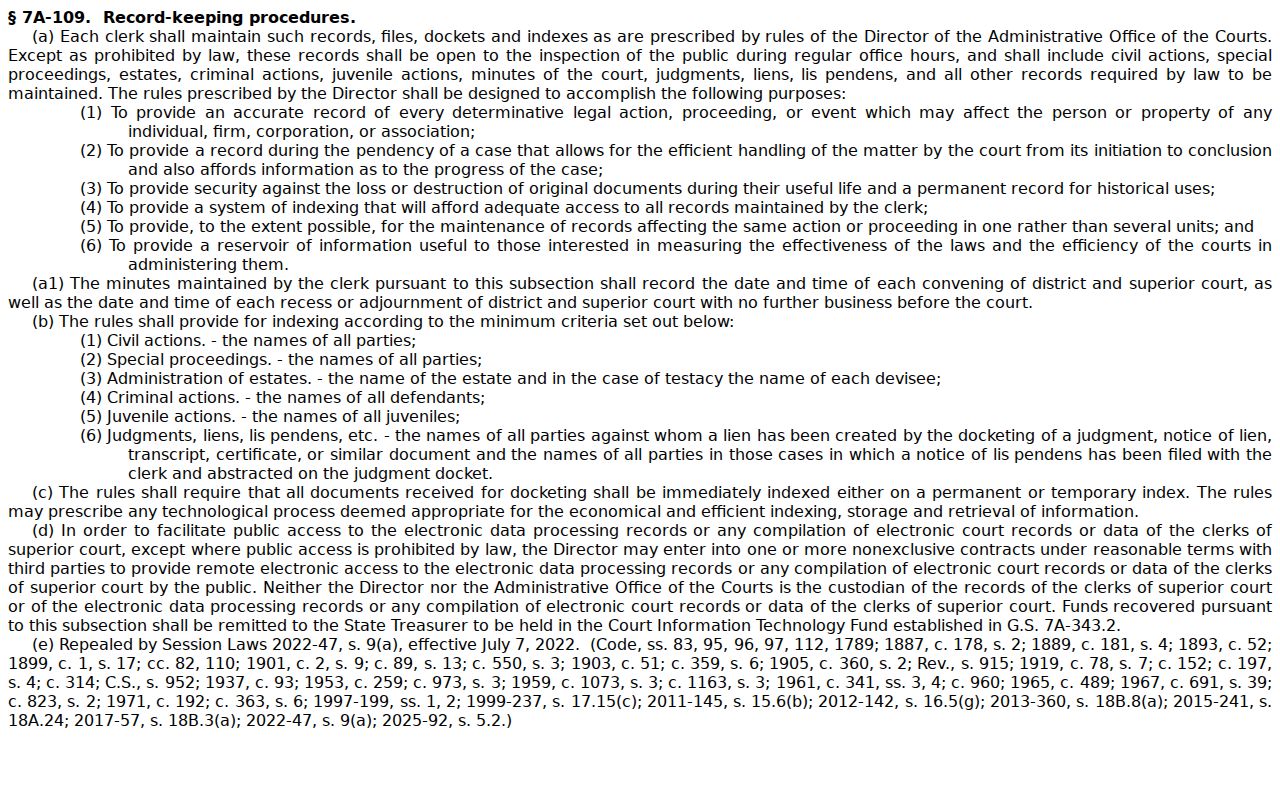
G.S. 7A-109 requires clerks to keep court records, files, dockets, and indexes. It generally opens them to inspection during regular office hours unless a law blocks access. Portal puts docket entries online. Its own guidance still says Portal is not the official record. For a public criminal case, the access path runs through Portal, then the criminal calendar or Search Hearings. The Mitchell clerk by phone comes next. The clerk-office terminal or paper file is the last stop when the web tools leave questions.
Copies and certified documents come from the Mitchell Clerk, never Portal. The county publishes no case-copy-by-mail procedure, copy fee schedule, or certified-copy postal instruction. Call before mailing any request. The statewide NCAOC public-record form fits records NCAOC holds. It is not the normal route for county case documents. And the local traffic-payment mail address is no substitute for a criminal file copy service.
Public-access rules.
G.S. 7A-109 keeps the clerk-record inspection baseline for records not barred by law.
G.S. 7A-308 sets statutory copy and certification components, including a $2 first page, $0.25 additional pages, a $3 seal, and a $10 exemplification.
G.S. 7B-3000 withholds juvenile records from public inspection except as the statute or a court order allows.
The official G.S. 7A-109 publication is the source for the clerk-record rule shown here.
Portal also leaves out sealed, confidential, and sensitive material. A missing online result can stem from spelling, format, a restriction, or another documented limit, and it is not proof that no record exists.
Mitchell Criminal Record Boundaries
Juvenile records sit under their own confidentiality statute. Sealed or expunged material never appears through the public Portal. Some protective-order material carries web-index or role-based limits. A courthouse terminal may confirm that a permitted protective-order case exists. It cannot override a restriction or a sealing order. The clerk can point you to the proper custodian without making nonpublic information public.
North Carolina Safe Babies Court serves Mitchell and Yancey Counties as a child-welfare program. Its official page describes that work. It is local court-system context, not a public criminal-search category. Its related juvenile matters remain confidential.
The program shows why one county can run a visible public docket system and a confidential court program side by side, without sharing public search access.